Scenario Sandbox & Product Anatomy
Supplementary material for the product portfolio · it does not replace that page
Pick your industry on the left to see how that kind of site is actually laid out and which products come into play, or switch to the product anatomy to see what each one solves. All text stays in the HTML — nothing is drawn into the canvas, and nothing moves when the view is still.
Interactive scenario sandbox
Read everything as text (all six scenarios and all seven products)
Sales scenarios
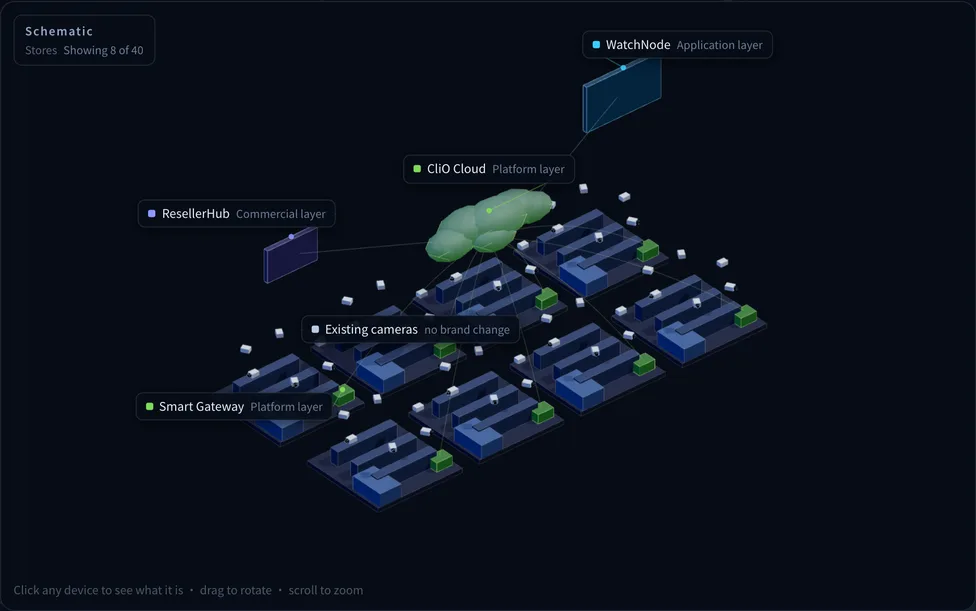
Chain retail / stores
Dozens or hundreds of stores spread across the country, none of them with a server room or an IT person. Head office needs to see all of it at once, and to know when a device has died.
Products in play
- CliO Cloud (Platform) — Pure-cloud VSaaS video service — no server room, subscribe and go
Without it: Every store buys its own NVR and disks, head office cannot see them together, and pulling footage means phoning the store manager to do it. - Smart Gateway (Platform) — Software only, runs on your own hardware — local device health checks, P2P remote access with no fixed IP or VPN
Without it: Every store needs a fixed IP or a VPN and firewall rules opened box by box; a dead device is usually discovered only when an incident happens and the footage is not there. - WatchNode (Application) — Industry-tailored dashboards, SOP-driven event dispatch
Without it: Events are just a pile of video: nobody is assigned to them and there is no handling record to audit. - ResellerHub (Commercial) — Unlimited reseller tiers, device-bound software licensing, automatic renewal reminders
Without it: Which machine a licence is bound to and when it expires are tracked in Excel, and every missed renewal is revenue straight off the top line.
Estimated at Stores 40, Cameras per store 6
| Cameras in total | 240 |
|---|---|
| Smart Gateway | 40 |
| Fixed IPs / VPNs avoided | 40 |
| Cloud uplink bandwidth (est.) | 360 Mbps |
| ResellerHub licence records | 280 |
Bandwidth assumes a 1.5 Mbps substream per channel; adjust to your recording policy. Gateway is software only and runs on a PC the store already has.
Large campus / buildings
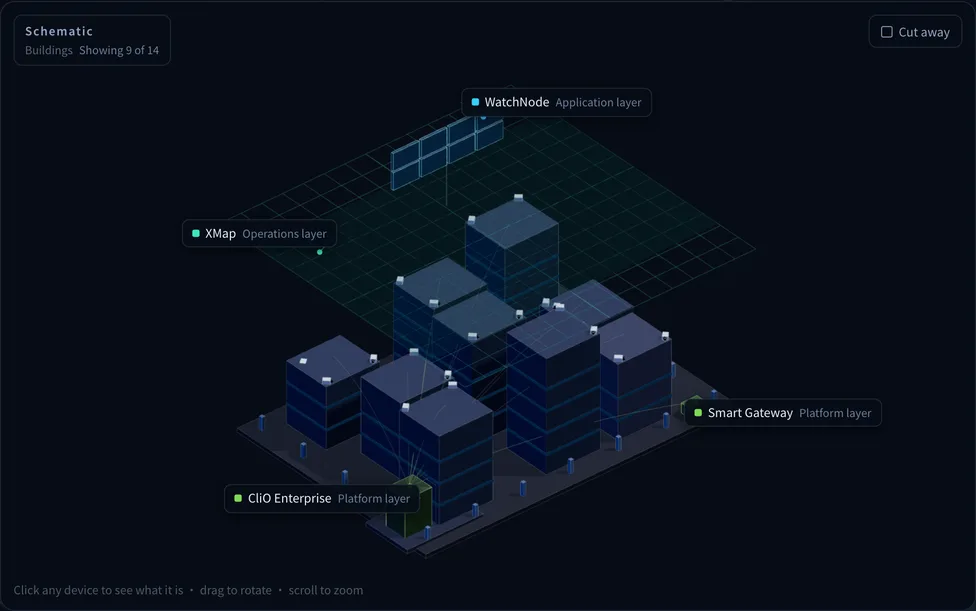
Dozens of buildings and thousands of cameras, bought from different vendors over a decade. It all has to appear on one video wall, and a single failed host must not blind the whole site.
Products in play
- CliO Enterprise (Platform) — On-prem advanced video management — cross-brand integration, video-wall hot standby
Without it: Mixed-brand devices cannot be brought into one system, so operators keep switching between consoles; with no hot standby, one host failure blinds everything. - XMap (Operations) — A web map layered over any VMS — Map View (3D) + CMS View
Without it: You cannot tell which building or floor a view belongs to, so locating an event depends on someone remembering camera numbers. - WatchNode (Application) — Industry-tailored dashboards, SOP-driven event dispatch
Without it: Alarms just flash on a screen — no dispatch, no deadline, no audit trail. - Smart Gateway (Platform) — Software only, runs on your own hardware — local device health checks, P2P remote access with no fixed IP or VPN
Without it: Legacy systems being absorbed need re-cabling and re-provisioning, which stretches out the rollout.
Estimated at Buildings 14, Cameras per building 60
| Cameras in total | 840 |
|---|---|
| CliO Enterprise nodes (est.) | 4 |
| Hot-standby node | 1 (N+1) |
| Video-wall tiles | 21 |
| XMap layers | 14 buildings × floors |
Assumes 256 channels per node; adjust to your bitrate and retention period.
Smart logistics / container yards
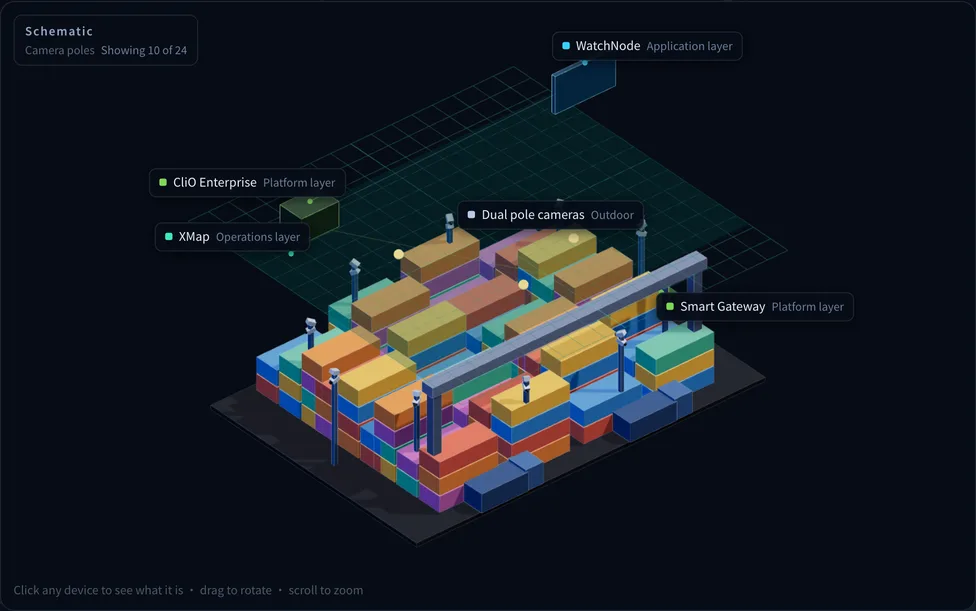
A yard of tens of thousands of square metres where nobody can tell which zone a camera view belongs to. Vehicle movement, container slots and events only mean anything once they are on the same map.
Products in play
- XMap (Operations) — A web map layered over any VMS — Map View (3D) + CMS View
Without it: You can see a vehicle breaking the rules but cannot say which zone or row it is in, so staff on the ground cannot find it. - Smart Gateway (Platform) — Software only, runs on your own hardware — local device health checks, P2P remote access with no fixed IP or VPN
Without it: Pole-mounted equipment going offline is only caught by walking the yard; after a thunderstorm it can go unnoticed for days. - CliO Enterprise (Platform) — On-prem advanced video management — cross-brand integration, video-wall hot standby
Without it: Without an on-prem node, every high-resolution stream has to go to the cloud, and the bandwidth cost is unacceptable. - WatchNode (Application) — Industry-tailored dashboards, SOP-driven event dispatch
Without it: Events are never dispatched, so the yard's SOP — who goes, how fast, photo confirmation — leaves no record.
Estimated at Container rows 12, Camera poles 24
| Pole cameras (2 per pole) | 48 |
|---|---|
| Rows covered | 12 |
| Smart Gateway | 2 |
| On-prem recording nodes | 1 |
| XMap hotspot layers | slots + lanes + events |
For outdoor poles, budget one Gateway per 16 poles for local health checks and consolidation.
Field patrol / fleet enforcement
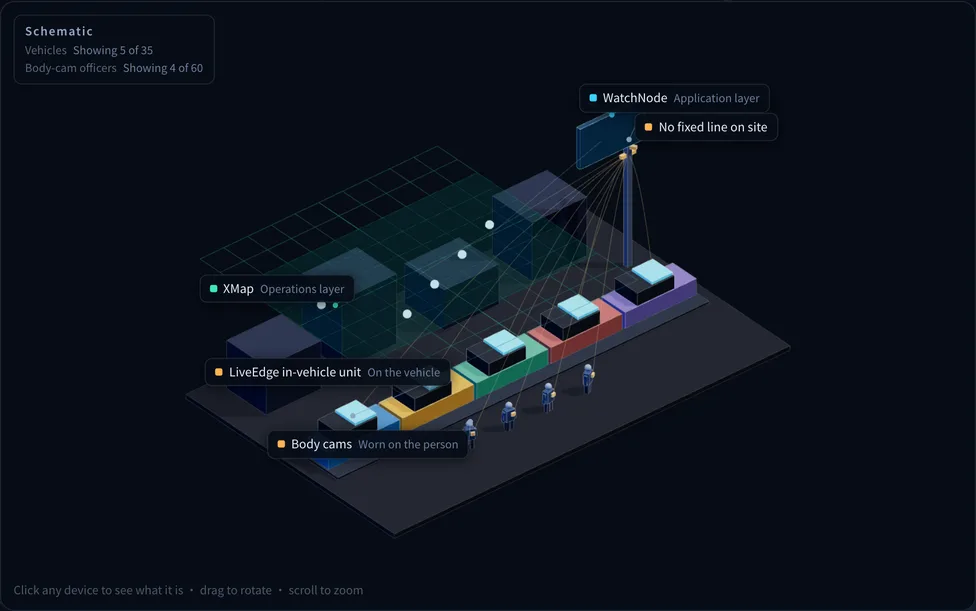
There is no network on site and both people and vehicles keep moving. Afterwards you must be able to produce credible video and location evidence, and during it you need to talk to the control room.
Products in play
- LiveEdge (Capture) — Mobile 4G live streaming, two-way audio and a GPS-backed chain of evidence
Without it: Footage stays inside the in-vehicle unit or body cam until the crew returns to base, and there is no way to talk to them in the moment. - XMap (Operations) — A web map layered over any VMS — Map View (3D) + CMS View
Without it: You know something has happened but not where each vehicle is or how far away, so you cannot dispatch the nearest crew. - WatchNode (Application) — Industry-tailored dashboards, SOP-driven event dispatch
Without it: The control room can only shout over the radio: no dispatch ticket, no timestamps, no closure record.
Estimated at Vehicles 35, Body-cam officers 60
| LiveEdge endpoints | 95 |
|---|---|
| Concurrent (est. 30%) | 29 |
| 4G uplink bandwidth (est.) | 34 Mbps |
| Mobile data per month (est.) | 15 GB |
| GPS track points / day (est.) | 821k pts |
Assumes 30% concurrent, 1.2 Mbps per stream and 4 hours of streaming a day — for a sense of scale only.
Custom projects / SOP dispatch
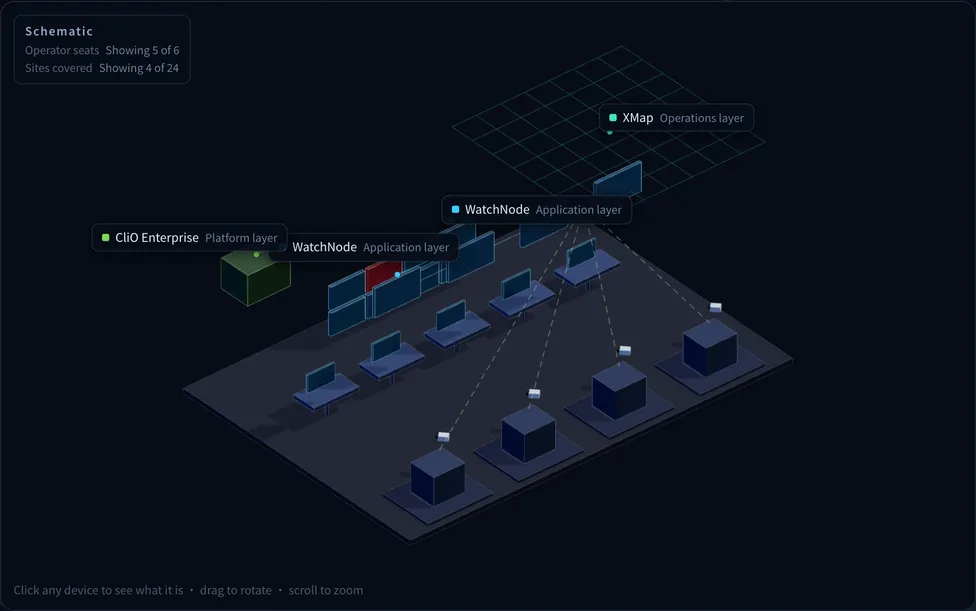
Every customer handles things differently, and a generic VMS screen is unusable for front-line staff. An incoming event needs an owner, a process to follow, and a record left behind.
Products in play
- WatchNode (Application) — Industry-tailored dashboards, SOP-driven event dispatch
Without it: Back to the generic VMS grid: you can see it, but there is no process, no ownership and no audit. - XMap (Operations) — A web map layered over any VMS — Map View (3D) + CMS View
Without it: Dispatch cannot state a precise location, so the front line has to ask by phone. - CliO Enterprise (Platform) — On-prem advanced video management — cross-brand integration, video-wall hot standby
Without it: The footage either side of an event is not available at the time, so the report is text only.
Estimated at Operator seats 6, Sites covered 24
| Operator seats | 6 |
|---|---|
| Sites covered | 24 |
| Load per seat | 4 sites/seat |
| SOP templates | tailored per site type |
| Event retention and audit | timestamped end to end |
The ratio of seats to sites is what drives both the quote and the SLA; WatchNode's SOP exists to push that ratio down.
Channel monetisation / licence billing
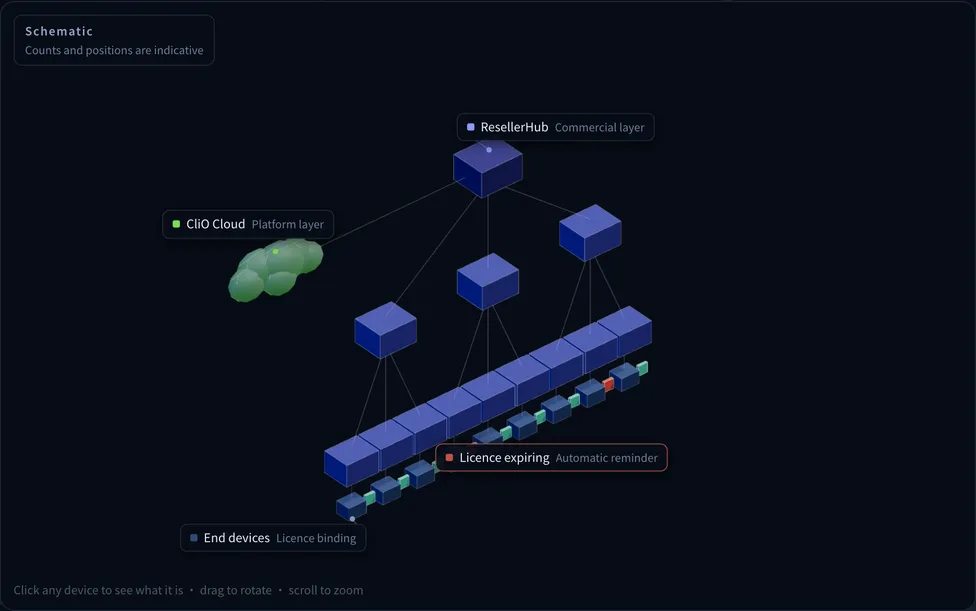
Resellers have resellers beneath them, and which machine a licence is bound to and when it expires is all tracked in Excel. Every missed renewal is revenue straight off the top line.
Products in play
- ResellerHub (Commercial) — Unlimited reseller tiers, device-bound software licensing, automatic renewal reminders
Without it: Ownership and expiry across multiple reseller tiers live in manual spreadsheets, and at any scale things will be missed. - CliO Cloud (Platform) — Pure-cloud VSaaS video service — no server room, subscribe and go
Without it: With no subscribable cloud product, the channel can only sell hardware once and earns nothing on renewal.
Estimated at Reseller tiers 3, Sub-resellers per tier 3
| Resellers in total | 12 |
|---|---|
| End customers (est.) | 36 |
| Licence records (est.) | 432 |
| Expiring for renewal each year | 432 |
| Ceiling for manual tracking | about 200 |
Assumes 4 customers per reseller and 12 licences per customer. The point where this passes what a person can track by hand is where ResellerHub starts paying for itself.
Product anatomy
LiveEdge (Capture)
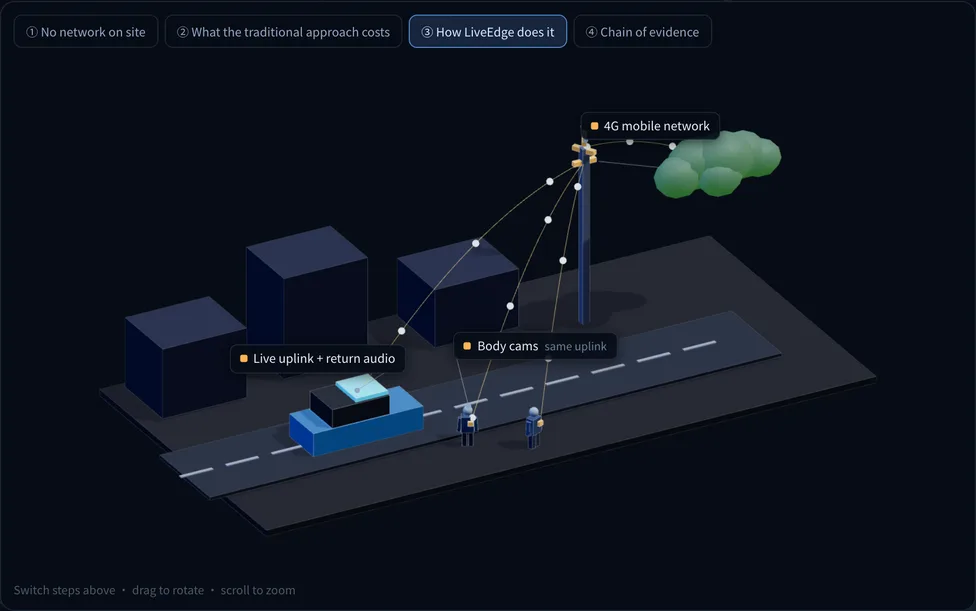
Mobile 4G live streaming, two-way audio and a GPS-backed chain of evidence
① No network on site — People and vehicles keep moving, and there is no fixed line
Field capture and fixed surveillance are different problems. There is no server room, no Wi-Fi, the position keeps changing, and afterwards you have to produce evidence. One LiveEdge, two carriers: a body-worn camera on the person and an in-vehicle unit on the car.
- No fixed line, no Wi-Fi:The mobile network is the only option.
- Location is information in itself:Footage without location and time is worth far less after the fact.
② What the traditional approach costs — Nothing is uploaded until the crew is back, so nothing can be done live
Footage stays in the device and is copied off only at the end of the shift. During the incident the control room is blind and cannot intervene.
- Latency measured in hours:Seeing the footage means waiting for the crew to return, which is no use in an emergency.
- No live intervention:The control room can only ask over the radio; it cannot see the scene.
- Broken chain of evidence:Copying, transcoding and filing by hand — every step is something that can be challenged.
③ How LiveEdge does it — Live 4G uplink with two-way audio
The endpoint pushes video back over the mobile network and opens a return audio channel at the same time — the control room does not just watch, it can talk.
- Live streaming:Visible while it is happening, not afterwards.
- Two-way audio:The control room can step directly into the situation, which one-way recording can never do.
- GPS uploaded in step:Video and location sit on the same timeline.
④ Chain of evidence — Video + GPS + time + officer, bound into one
All four are bound together and sealed at the point of capture, so any later substitution is detectable. In enforcement and audit work, this is what is actually being bought.
- Four-way binding:Miss any one of them and the record can be challenged later.
- Sealed on upload:No manual transcoding, so there are fewer steps anyone can dispute.
- Auditable:Who viewed or exported it, and when, is all on record.
Smart Gateway (Platform)
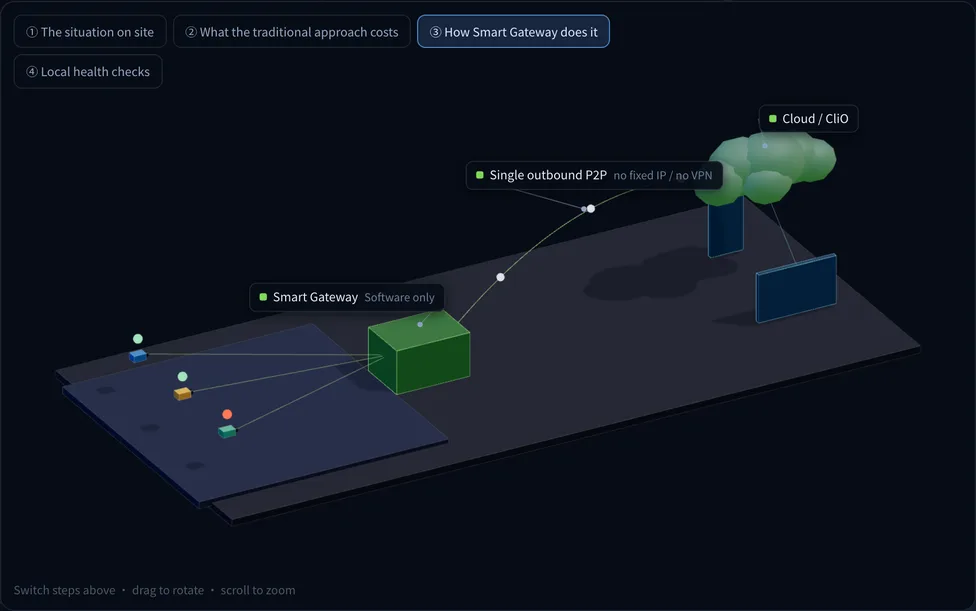
Software only, runs on your own hardware — local device health checks, P2P remote access with no fixed IP or VPN
① The situation on site — A decade of accumulated, mismatched equipment
No customer replaces every camera to suit your system. Any solution has to start by accepting that the site is multi-brand and multi-generation.
- Three brands, three protocols:Kit from three vendors online at once, each with its own management console.
- No IT staff:Stores, plants and yards rarely have anyone on site who can configure a network.
② What the traditional approach costs — Every site needs IT involved
To see in from outside, the traditional route is a fixed IP or a VPN plus firewall rules opened device by device. Across many sites that becomes a permanent monthly cost and a permanent configuration job.
- Fixed IP or VPN:One monthly fee and one setup job per site — multiply by the number of stores in a chain.
- Firewall opened device by device:Opening inbound paths is something security will usually refuse, or drag through a long process.
- Device status checked by hand:A broken camera is usually discovered when an incident happens and the footage is not there.
③ How Smart Gateway does it — One connection built outward, nothing opened inward
Gateway is software only, installed on a machine the customer already has. It collapses the site's mismatched devices behind one interface, then opens a P2P channel outward from the inside.
- Software only, on your own hardware:No box to buy — it runs on the PC or NAS already there.
- P2P with no IP and no VPN:The connection is made outward, so no inbound port is ever opened.
- Mixed brands consolidated:Mismatched devices are unified at this layer, so everything above sees one interface.
④ Local health checks — When a device dies, you know before the customer does
Gateway polls every device continuously on the local network. Going offline, a bad image or a recording gap is reported straight away, rather than surfacing when footage is needed and missing.
- Active polling:It does not rely on devices reporting themselves; Gateway checks them directly on the same LAN.
- Immediate offline alert:The Brand C unit is already offline — something you know before anything happens.
- An SLA you can commit to:Once device availability can be measured, a maintenance contract becomes negotiable.
CliO Cloud (Platform)
Pure-cloud VSaaS video service — no server room, subscribe and go
① The situation on site — Every store is an island with no IT
Chain retail is not one big project but dozens or hundreds of small ones. Any approach that needs a skilled pair of hands on site has its cost multiplied by the store count.
- No server room:Floor space in a store is for selling things, not for housing servers.
- No IT staff:What a store manager can be asked to do stops at the power switch.
- Head office needs to see everything at once:Not phone each store and ask them to find the footage.
② What the traditional approach costs — One NVR per store, with the cost hidden in the next three years
Buying the box is only the first line item. Disk life, capacity expansion and the labour of retrieving footage all grow linearly with store count.
- Disks are consumables:Nobody notices at the time; it surfaces when footage is needed and was never recorded.
- Expansion means replacement:Want another 30 days of retention? On most models that means a whole new unit.
- Retrieving footage means a site visit:Travel cost times stores times occurrences — an arithmetic few people actually do.
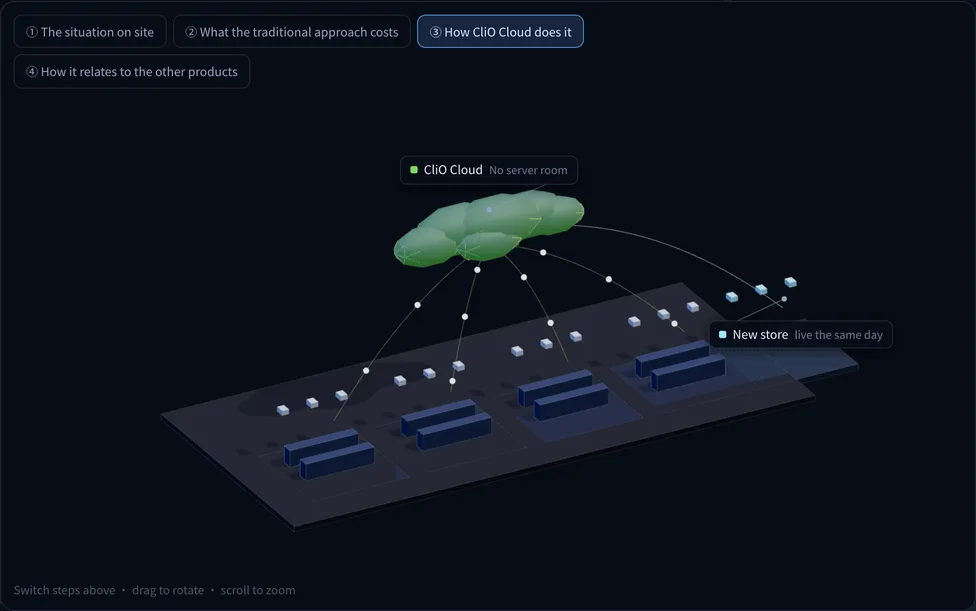
③ How CliO Cloud does it — Nothing left in the store that needs maintaining
Video goes straight to the cloud and the store keeps only its cameras. Opening a store starts a subscription; closing one ends it.
- No server room:No server, no disks, no UPS batteries to replace.
- Live on opening day:A new store goes live the same day, with no wait for hardware or an engineering slot.
- Predictable cost:A subscription turns the IT cost of opening stores into a number that fits in a financial model.
④ How it relates to the other products — The cloud is only the middle layer
Below it, CliO Cloud needs Smart Gateway to bring mixed-brand devices in; above it, it needs ResellerHub to become a billable business.
- Below: Smart Gateway:No camera replacement required — existing mixed-brand kit comes in as it is.
- Above: ResellerHub:Subscriptions have to be bindable, billable and self-reminding before the channel has any reason to sell them.
- Alongside: CliO Enterprise:Large customers can run mostly on-prem and put the important footage in the cloud, through one interface.
CliO Enterprise (Platform)
On-prem advanced video management — cross-brand integration, video-wall hot standby
① The situation on site — The estate grew in batches over a decade
On a large campus nothing is ever built in one pass. Brand A from 2015, Brand B from 2019, Brand C in the 2024 block — all still in service.
- The kit is fine; it just does not interoperate:Every batch was a reasonable purchase at the time.
- Replacement is not an option:No customer signs off the budget to swap out a thousand cameras at once.
- But there is only one duty team:They should not have to open three systems to look at one incident.
② What the traditional approach costs — Three systems side by side, each a single point of failure
Each vendor's VMS works on its own, but there is no shared event model between them and no fallback when a machine dies.
- Three logins, three interfaces:It triples the operator's cognitive load, and the handover and training cost with it.
- Events cannot be correlated across systems:One person walking from zone A to zone C is two unrelated events as far as the systems are concerned.
- Single point of failure:With no redundancy, one dead host takes an entire batch of cameras with it.
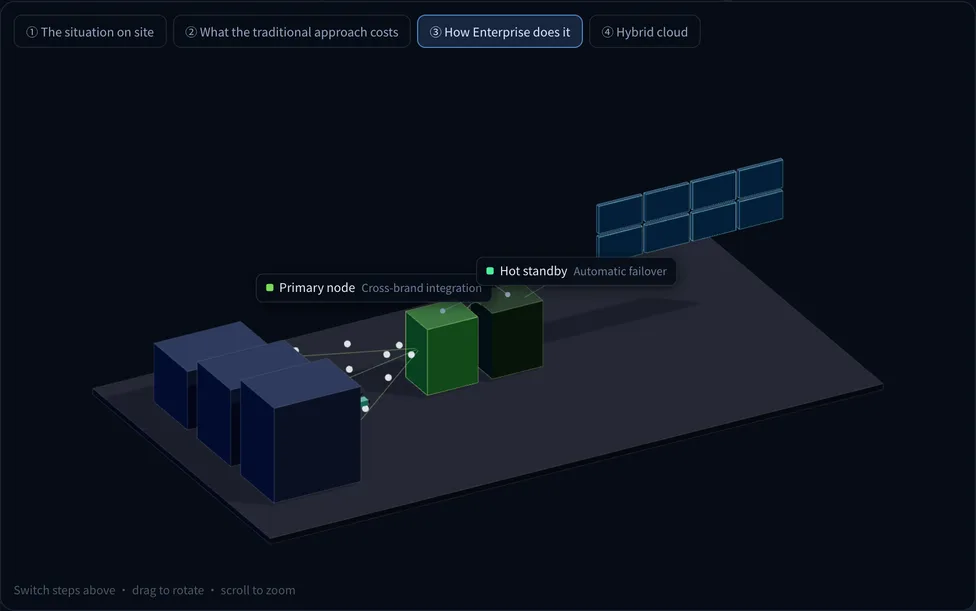
③ How Enterprise does it — Consolidate every brand, then add a hot standby
Three generations of equipment become one interface at this layer. Primary and standby stay in sync, and the standby takes over automatically if the primary drops.
- Cross-brand integration:Everything above sees one interface, one permission model, one event format.
- Video-wall hot standby:The duty view does not go dark because one host failed.
- An SLA you can commit to:Redundancy is what makes a maintenance contract negotiable — a commercial difference, not just a technical one.
④ Hybrid cloud — On-prem by default, cloud for what matters
No customer accepts the bandwidth bill for pushing a thousand high-resolution channels to the cloud. In practice you split it: routine footage stays on site, and only what needs off-site protection goes up.
- Uplink bandwidth saved:Only flagged event clips ever leave the site.
- Off-site protection:If something happens to the on-site server room, the critical evidence still exists.
- One interface:The user never has to know where a given clip currently lives.
XMap (Operations)
A web map layered over any VMS — Map View (3D) + CMS View
① The situation on site — Hundreds of cameras, and no view tells you where it is
Campuses, yards and junctions all share this: the video carries no geography. The first question about any clip is always "where is this?"
- Cameras are a list, not a map:CAM-01 through CAM-800, with the locations held in someone's head.
- Events cannot be located:You know something happened but cannot say which building, floor or row.
② What the traditional approach costs — A video grid cannot answer "where"
The traditional VMS answer is to cram more tiles onto one screen. More tiles only makes the locating problem worse.
- It depends on people, not places:It rests on an experienced operator's memory, and breaks the moment they leave.
- Dispatch cannot be precise:With no exact location, the front line has to get there and then search.
- Across systems it is worse:Different buildings run different VMSs, and even the numbering conventions differ.
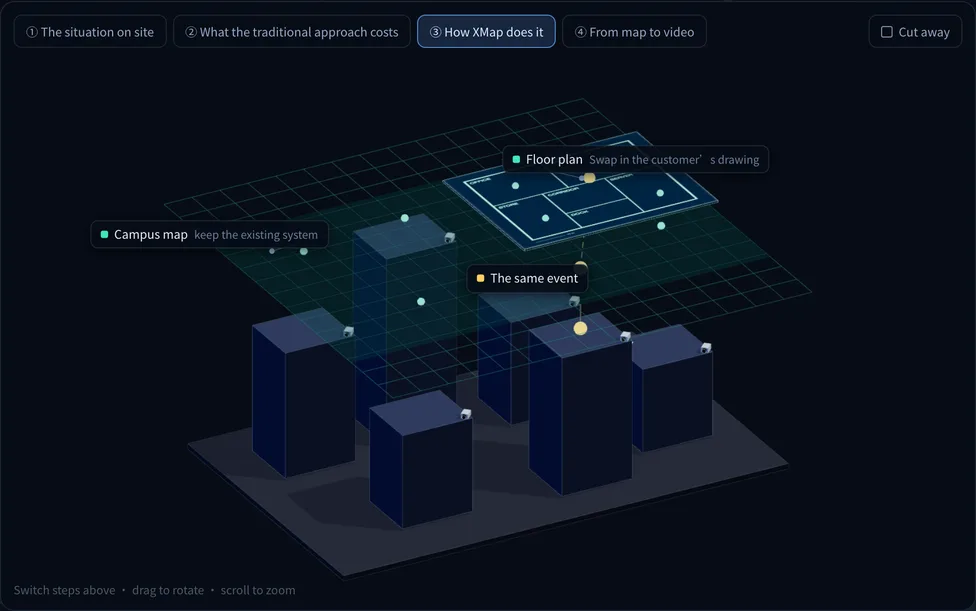
③ How XMap does it — Putting video back into geographic context
XMap is a web map layered over the VMS already in place; the customer keeps their system. Cameras, events and assets all hang on the map, and when detail is needed you drill from the campus down to the floor plan.
- Layered over, not replacing:Cameras from any brand or system share one map.
- Events land on a place:An alarm lights up on the map rather than arriving as a number.
- Drill down to the floor:A real floor plan layers over the campus map, and it can be swapped for the customer’s own drawing.
④ From map to video — Map View and CMS View are the same data
Click the map and you are in the video; an event in the video takes you back to the map. Both views share one permission model and one event model.
- Two-way:Map to video, video to map.
- One permission model:No gap where the map shows something the video cannot produce.
- Connects to WatchNode:An event goes from the map straight into SOP dispatch.
WatchNode (Application)
Industry-tailored dashboards, SOP-driven event dispatch
① The situation on site — Being able to see it is not the same as someone handling it
Most surveillance projects stop at "you can retrieve any clip". What the customer is actually buying is whether things got dealt with.
- Plenty of events:The larger the site, the more the daily alarm count exceeds what people can assess one by one.
- Every customer's process differs:A generic VMS screen is not directly usable by front-line staff.
- Audit needs a record:When something goes wrong, who did what and when has to be produceable.
② What the traditional approach costs — Once it is said over the radio, there is no record
The operator sees a red box, picks up the radio, and someone on site answers "received". Not one step of that lands in a system.
- No dispatch record:Who took it, when they arrived and how it ended live only in the memory of those involved.
- No deadline:An event nobody is tracking is an event that gets quietly forgotten.
- No audit:When the customer asks for a monthly report, it is reconstructed from memory.
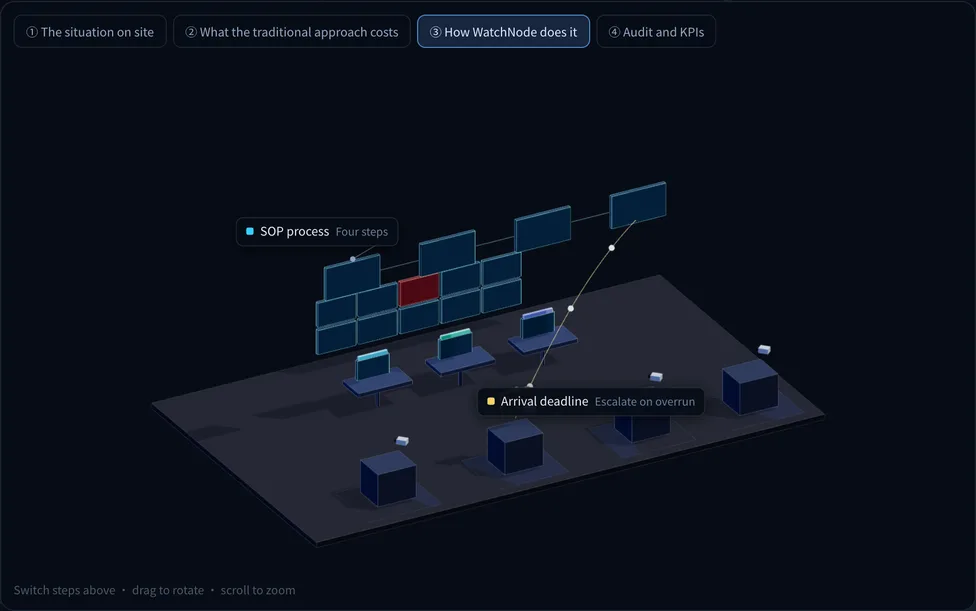
③ How WatchNode does it — Turning an event into an action someone owns
Event arrives, is graded by type, assigned to a person, given a deadline, then closed on arrival with a report. Every step stays in the system.
- Screens built per role:Different seats see different dashboards, not one generic screen.
- SOPs bound to event types:Each event type has its own steps and required fields, and cannot be closed until they are complete.
- Deadlines and escalation:Overrunning escalates automatically instead of vanishing into a to-do list.
④ Audit and KPIs — With numbers, a maintenance contract becomes negotiable
Once every event is timestamped, mean time to arrival, closure rate and overdue count fall out on their own. That is what turns a one-off project into a long-term contract.
- Measurable:No longer "we handle things well" but "mean arrival this month: 6 minutes 12 seconds".
- Auditable:Who viewed it, who exported it and who closed it are all on record.
- SLA-ready:Numbers make commitments possible, and commitments are what a management fee is charged for.
ResellerHub (Commercial)
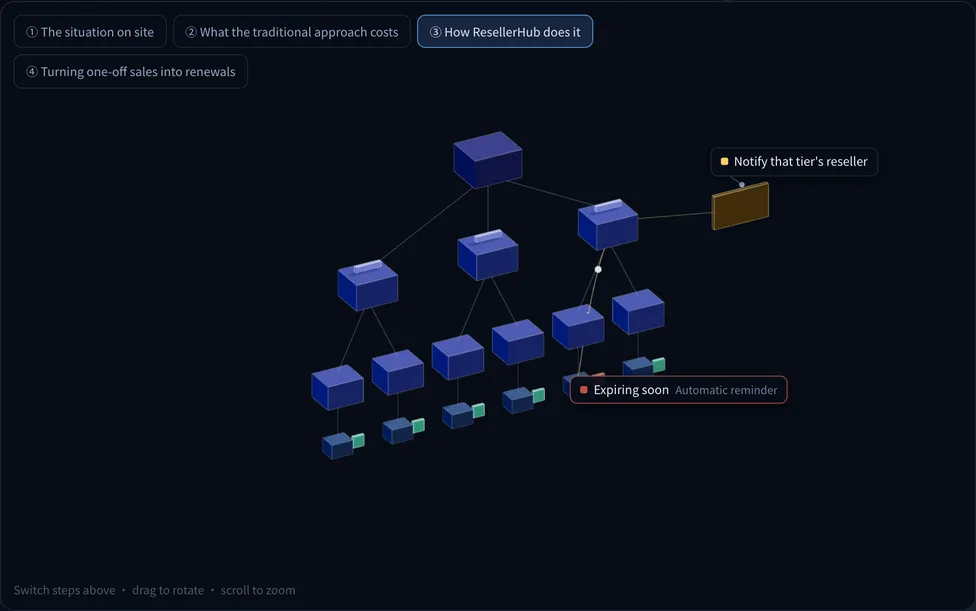
Unlimited reseller tiers, device-bound software licensing, automatic renewal reminders
① The situation on site — Resellers have resellers beneath them
The channel is not one layer. Vendor, distributor, systems integrator, end customer — each tier has its own discounts, quotas and customer relationships.
- The depth varies:Some markets stop at two tiers, others need four. The system has to accommodate that rather than dictate it.
- Licences bind to devices:Not to a person or a company, because the device is what is actually in use.
- The vendor cannot see the end customer:That is inherent to selling through a channel, but it does not mean licence status has to be a black box too.
② What the traditional approach costs — Under two hundred records, Excel genuinely works
The problem is not that Excel is bad, it is that it does not scale. Once the licence count passes what a person can track, every missed renewal is revenue lost outright.
- Reconciliation by hand:Which machine, which version, bound to which customer — all kept current by someone remembering to update it.
- Expiry by memory:An expiry date nobody is reminded of is a date that passes.
- Missed = revenue lost:And it is usually the customer's call to say it has stopped working that tells you.
③ How ResellerHub does it — Binding, tiering and automatic expiry reminders
A licence binds to a device, belongs to a reseller at some tier, and announces itself before it expires. Unlimited tiers, with no assumption about the shape of your channel.
- Unlimited tiers:Two tiers or four, each with its own discounts and quotas.
- Automatic expiry reminders:The reminder goes to that tier's reseller and to the vendor at once, with nobody checking a spreadsheet.
- Device binding:Swaps, returns and transfers are all recorded and produceable at audit.
④ Turning one-off sales into renewals — What the channel actually cares about is whether there is revenue next year
Selling a box pays once. A cloud subscription plus licence renewals is revenue that returns every year and compounds — provided no renewal is missed.
- One-off vs renewal:For the same customer, by year five the difference is several times over.
- Renewal rate is the lever:The compounding curve depends on not losing existing contracts, and a missed renewal is missed compounding.
- It gives the channel a reason to sell:Resellers put sales resource behind products that pay them again next year.